All-on-4 Dental Implants in Turlock, CA
Four implants, two of them tilted at the back, carrying a full arch. Here is what that protocol does and where its limits are.
Medically reviewed by Dr. Broneil Ishaya, DDS — Fellow, Misch Resnik Institute of Implantology · Oct 2026 · Written by Dr. Ishaya
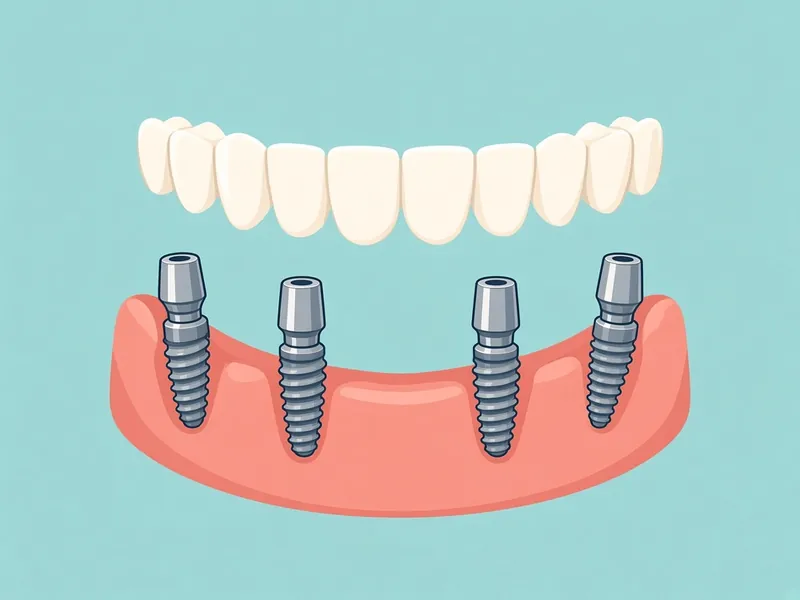
In short: All-on-4® dental implants are a full-arch protocol in which four implants support a complete set of upper or lower teeth, two placed straight at the front and two tilted at the back to reach available bone, usually with a fixed provisional arch fitted the same day. It is one way of doing full-arch treatment rather than a separate treatment, and the details below are what distinguish it.
What full-arch treatment is, who it suits and what healing involves are covered on full-arch dental implants; this page stays with the All-on-4 protocol itself. Read that page first if the category is new to you.
What makes All-on-4 different
What distinguishes All-on-4 is the tilt of the two rear implants and the provisional arch fitted the same day, and both exist to solve problems a straightforward arrangement creates.
The anatomy is the difficulty. In the upper jaw the maxillary sinus (the air-filled cavity above the back teeth) descends as teeth are lost, leaving too little bone height for a vertical implant. In the lower jaw the mental nerve exits in the premolar region, and a vertical implant behind it risks the sensation in your lip and chin. The tilted implant changes the angle instead: the posterior (rear) implant leans backward, its head where the tooth must emerge and its body travelling along the front wall of the sinus, or ahead of the nerve loop, in bone already there. The two anterior (front) implants go in vertically where bone quality is best, so the four spread the load across the arch.
The second half is the provisional. A fixed acrylic arch is designed before surgery and fitted at the surgical visit, so you do not leave without teeth. It keeps the bite off the healing sites and doubles as a rehearsal, letting lip support, tooth position and speech be judged while changes are still cheap.
All-on-4, All-on-6 and All-on-X: how to tell which fits
All-on-4 uses four implants, All-on-6 uses six, and All-on-X describes any full-arch case where the number is chosen for the patient rather than fixed in advance. More implants buy support, not prestige, and the right number comes from the scan.
Four is the minimum for a full arch, and it is the number the protocol is built around. Each extra implant shortens the span the others carry, which matters with low bone density, a heavy bite or grinding habit, or a wide arch. A cantilever is the distance the final arch projects past its last implant; the longer it is, the more strain that implant takes, and another implant is one way to shorten it.
No single number is better: four in dense bone with a moderate bite can serve longer than six in poor bone with a heavy clencher. What matters is that the number is argued from your CBCT, your bite and your history.
Is the tooth you leave with final?
Usually not. The arch fitted on the day of surgery is a provisional, worn through the healing period while the implants integrate (the bone fusing to the implant surface), and the final prosthesis is made months later once the foundation is stable.
This is the most misunderstood part of All-on-4 marketing, so it is worth being blunt: "teeth in a day" is accurate about the day, not a statement that the work is finished. The provisional is a functional acrylic arch made to look right and let you eat soft food, deliberately lighter than the final, and it lets the gum heal and the bite settle before the final is designed. The final is usually milled zirconia or a zirconia-acrylic hybrid, designed from a new scan and often tried in before delivery.
Immediate loading, meaning the provisional is fixed and functional from day one, is possible in many cases but not all. It depends on the torque the implants achieved in bone, the bite, and your cooperation with a soft diet. Where an implant is less stable than planned, the safer course is a provisional kept out of function for a while — decided at the chair from the readings, not promised at the consultation.
Who All-on-4 suits, and who it doesn't
All-on-4 suits an adult who has lost or is losing most teeth in one arch and has enough bone in the right places for four implants, which the CBCT establishes. It does not suit every arch.
Bone volume is the first test. The protocol is forgiving of resorption because the tilted implants reach bone a vertical one cannot, but an arch resorbed to a thin ribbon may need grafting or more implants. Gum health is addressed first, because active periodontal disease raises the risk that the same process reaches the implants.
Medical history changes the plan more than age does. Uncontrolled diabetes impairs healing; smoking raises the failure rate; bisphosphonate or other antiresorptive medication must be disclosed, because it affects bone turnover and can rule out elective jaw surgery. None of these automatically disqualifies you, and each belongs in the assessment alongside the bite.
When the anatomy does not cooperate, the better answer may be bone grafting first and implants later, a segmented approach with separate bridges, or a removable implant-supported denture. The candidate guide sets out the general factors in more detail.
How treatment runs here
Treatment here follows five stages: a consultation with a CBCT and an iTero scan, a written plan, the surgical visit with a provisional arch, several months of healing, then the final prosthesis and a maintenance schedule.
The consultation is free and the most planning-intensive appointment here. The CBCT shows bone height, width and density across the arch and the position of the sinus and nerves; the iTero scan records the teeth and bite; photographs record how your lips and face are supported now. Dr. Ishaya designs the implant positions in that image and decides whether four, five or six are needed and which will be tilted.
The surgical visit is long, often several hours: remaining teeth come out, implants go in under local anesthesia with sedation available, and the provisional arch is fitted. Healing runs for months with a modified diet, and the final arch is designed from a new scan once the tissue settles. The step-by-step process covers the appointments; full-arch dental implants covers healing and risks.
What changes the fee
The fee is set by the number of implants, whether grafting or extractions join the plan, the material of the provisional and the final arch, and whether sedation is used. No figure is given on this page.
Implant count is the largest variable, since each implant carries a surgical fee, a component and a laboratory line. Grafting, a sinus lift or multiple extractions add cost and time; the provisional and the final prosthesis are both real costs; sedation adds a medication and monitoring fee. A useful estimate separates the surgical phase from the restorative one and names its exclusions. Fees and offer terms are on Current Offers; cost and financing takes each driver apart.
Insurance and paying for treatment
The practice accepts most PPO dental plans, and most plans now contribute something toward implant treatment. What a plan pays depends on how it classifies the implant, the restoration and any grafting, on your annual maximum, and on whether pre-authorization is required before surgery.
Bring your insurance card to the consultation and we will work through the benefit breakdown with you at no charge, so you know what your plan would cover and what the balance would be before you commit to treatment. If you do not have dental insurance, ask about the current offers for patients paying without a plan.
Common questions
Is All-on-4 the same as All-on-X?
No. All-on-4 is one specific arrangement, four implants with the rear pair tilted; All-on-X is an umbrella term for any full-arch treatment on a number of implants chosen for the case, which may be four, five, six or more. All-on-4 is therefore a subset of All-on-X, and a practice offering All-on-X may use four implants or may not.
Can all my teeth be replaced in one day?
Usually the teeth are removed and the implants placed in one appointment, and a fixed provisional arch is fitted the same day or within a few days. Whether immediate loading is safe for you depends on how stable the implants are in bone and on your bite, and that is decided from the CBCT before surgery rather than promised in advance.
How many implants will I need?
Four is the minimum for a full arch and the number most All-on-4 cases use, but five or six are chosen when bone density, bite force or arch width call for more support. The count is set from the CBCT, not selected from a menu, and the reason for the number you are given should be explained to you.
Does All-on-4 need bone grafting?
Often not, which is one of the reasons the protocol exists: tilting the rear implants lets them engage bone in front of the sinus and above the mental nerve, avoiding the areas that usually need grafting. Where the remaining bone is too thin even for that, a graft or a different option becomes the better plan.
How long does the whole process take?
The surgical visit and the provisional arch happen at the start, then several months of healing follow while the implants integrate, and the final prosthesis is made after that. Bone grafting, if it is needed, adds its own healing time before implants go in.
Whether All-on-4 is right for you can only be decided after an exam and a CBCT scan. Every case differs, and results vary.
Sources
Find out whether four implants, or more, is the right plan for your arch.
Book a free consultationFull-arch rehabilitation replaces an entire arch of teeth with a fixed prosthesis carried on a small number of implants. The term All-on-4 refers to a specific approach popularized with a particular implant system, in which four implants support the arch, with the posterior two placed at an angle to avoid the sinus in the upper jaw or the nerve in the lower. It is a trademark of Nobel Biocare; we use the phrase only to describe the concept and are not affiliated with that company. iTero® is a registered trademark of Align Technology, Inc.; This site is not affiliated with Align Technology.